Research and Art
UNESCO
Chair on Teacher Education for Sustainable Development
Chairholder: prof. dr. Gregor Torkar
Chairholder: prof. dr. Gregor Torkar
Presentation of the UNESCO Chair on Teacher Education for Sustainable Development
The purpose of the Chair is to promote an integrated system of research, teaching and training, as well as community engagement and communication. The Chair will facilitate collaboration between high-level, internationally recognized researchers and teaching staff of the University of Ljubljana and other institutions in the country, as well as elsewhere in the region and in other regions of the world.
The specific objectives of this Chair are to:
Chairholder: Prof. Gregor Torkar, PhD, University of Ljubljana, Faculty of Education, Kardeljeva ploščad 16, 1000 Ljubljana, Slovenia, E: gregor.torkar@pef.uni-lj.si
ESD Beyond 2030 is about transforming education so that people of all ages have the knowledge, skills, values and opportunities to collectively navigate uncertainty and actively create more sustainable, peaceful and just societies.
UNESCO is looking at how Education for Sustainable Development (ESD) should evolve after the 2030 Agenda ends. The main idea is that education needs to do more than teach people about sustainability—it should equip learners to actively shape sustainable, peaceful and just futures.
A major part of this process was the Global Expert Symposium on ESD Beyond 2030, held in Munich in September 2026. Experts from governments, universities, civil society, youth organizations and international institutions discussed what ESD should look like in the future.
Key ideas include:
What happens next?
The Munich discussions will feed into the UNESCO World Conference on Education for Sustainable Development in Nairobi in January 2027. The longer-term goal is to develop a shared vision and priorities for ESD beyond 2030, building on the existing ESD for 2030 Framework and the 2023 UNESCO Recommendation on Education for Peace, Human Rights and Sustainable Development.
UNESCO launches new guidance tools to strengthen Education for Sustainable Development in education systems
Three new UNESCO guidance tools provide practical support for embedding Education for Sustainable Development across education systems – with Slovenia playing an active role in their development and piloting.
On 17 September 2026, UNESCO launched three new guidance tools designed to help make Education for Sustainable Development (ESD) a stronger priority within education systems and to support education’s contribution to more sustainable, peaceful and just societies. The tools were developed through the international project Transforming Futures: Enhancing Practice for ESD for 2030 through Action Research and were piloted across ten countries, providing a foundation for further strengthening ESD in schools and education institutions worldwide.
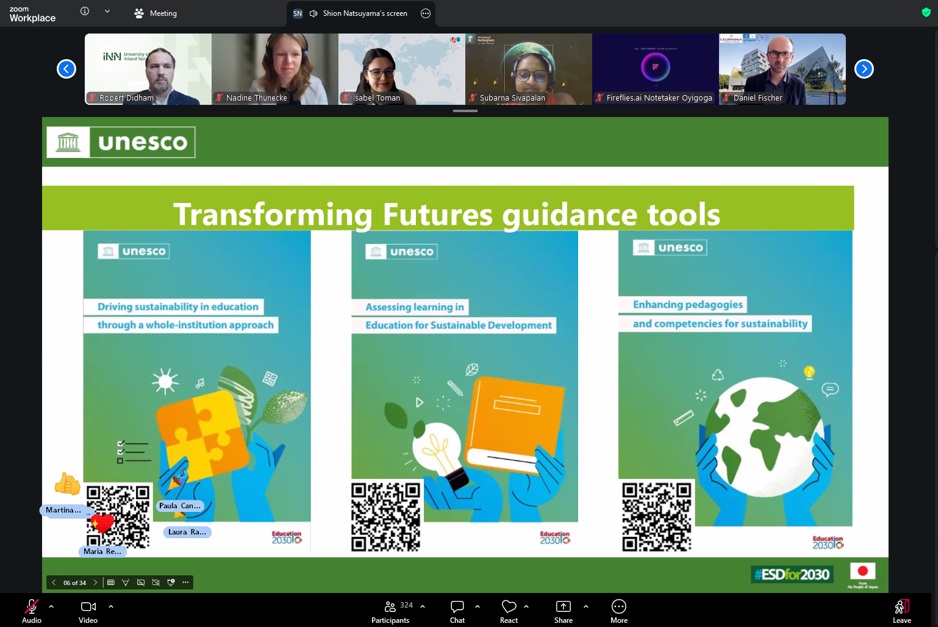
The Transforming Futures project addresses three interconnected dimensions that are essential for strengthening ESD in education:
To ensure that the guidance would be relevant across different cultural, social and political contexts, UNESCO involved ten countries: Brazil, Japan, Germany, Romania, Kenya, Malaysia, Costa Rica, Cuba, Côte d’Ivoire and Slovenia. The project involved 41 institutions and drew on action research carried out in local educational contexts.
Slovenia was one of the ten countries participating in the project. The Slovenian component was coordinated by the UNESCO Chair on Teacher Education for Sustainable Development at the University of Ljubljana, based at the Faculty of Education.
The Slovenian involvement connects the international development of the tools with the realities of education in Slovenia and contributes Slovenian perspectives and experiences to the global ESD community. Through this collaboration, Slovenian schools and education stakeholders have had the opportunity not only to use and test the emerging guidance, but also to contribute to its further development. The Slovenian experience illustrates the value of connecting international frameworks with local educational contexts. ESD cannot simply be transferred from one context to another; it needs to be interpreted, adapted, tested and developed together with educators and institutions working in their own social, cultural and environmental settings.
The publication of the three tools is an important step, but their value ultimately depends on how they are used in practice. The Transforming Futures project places particular emphasis on action research precisely because meaningful educational transformation requires continuous cycles of action, reflection, learning and improvement.
The tools therefore offer more than recommendations. They provide a basis for schools, universities, teacher educators, policymakers and other educational stakeholders to examine their own practices, identify opportunities for change and develop context-sensitive approaches to sustainability.
The launch also opens the next phase of the initiative: moving from piloting and guidance development towards wider implementation, collaboration and learning across education systems. In this sense, the Transforming Futures project contributes to the broader UNESCO ambition of strengthening ESD as an integral part of quality education and preparing education systems for the sustainability challenges of the coming decades.
The three publications are freely available through the UNESCO Digital Library:
More information about the project is available on the UNESCO Transforming Futures project page.
The project is further supported by emerging research on transformative whole-institution approaches and sustainability competencies:
The launch of the Transforming Futures guidance tools marks an opportunity to move from shared ambition towards sustained action. For educators, researchers, policymakers and institutions working to strengthen Education for Sustainable Development, the three tools offer a common starting point for reflection, collaboration and transformation. Education for sustainable development is not only about what learners know. It is also about how educational institutions operate, how teaching enables learners to engage with complex challenges, and how education supports people and communities in creating more sustainable futures.
VIDEO:
Transforming Futures: New UNESCO guidance tools for education for sustainable development
Student Ambassador of the UNESCO Chair on Teacher Education for Sustainable Development (2026/27 academic year)
Students attending the Erasmus+ Blended Intensive Programme “Environment and Sustainable Development,” held in Ljubljana, Slovenia, from 20 to 24 April 2026, have been appointed Student Ambassador of the UNESCO Chair on Teacher Education for Sustainable Development for the 2026–27 academic year. As a Student Ambassador, they are part of a community of students supporting the values and activities of the UNESCO Chair and contributing to the promotion of teacher education, sustainability and sustainable development.
ESD-NET Europe–North America Regional Workshop
The regional workshop took place from January 21 to 23, 2026, in Bucharest, Romania, organized by UNESCO. The event brought together representatives of the ESD-NET network from Europe and North America to review progress, challenges, and future directions in Education for Sustainable Development (ESD).
Participants discussed key topics such as integrating sustainability into education systems, climate resilience, biodiversity conservation, and the broader social and political context. Particular emphasis was placed on practical, action-oriented approaches and on strengthening the links between policy, practice, and research. The workshop also provided an opportunity to reflect on how the regional network can more effectively contribute to shaping global ESD priorities beyond 2030.
The main objectives included sharing experiences in implementing the ESD for 2030 framework, strengthening knowledge and competencies, developing a joint regional action plan, and preparing for the 2026 global ESD conference. Participants highlighted the importance of cooperation among countries, institutions, and stakeholders, as well as the need for coordinated and long-term approaches.
Regional and national initiatives were presented, including UNECE and UNEP strategies addressing environmental and climate challenges. Countries shared good practices related to curriculum development, teacher training, and youth engagement, while also pointing out challenges such as limited political support, capacity constraints, and unequal access to resources.
Discussions also emphasized the importance of a whole-institution approach to education and the need to better assess the real-world impact of ESD in practice. Participants stressed the role of youth as active contributors to change and the importance of inclusive dialogue with diverse communities.
A significant part of the workshop focused on the Greening Education Partnership, which promotes environmental sustainability in education. Participants highlighted the need for greater alignment among existing frameworks, indicators, and tools, as well as for a clear long-term vision for the development of ESD.
The concluding session focused on future steps, where participants emphasized the importance of improved communication, regular collaboration, knowledge sharing, and youth engagement. Key recommendations included strengthening regional cooperation, better aligning policies and practices, and developing practical tools to support the implementation of ESD in educational environments.
The workshop was attended by Prof. Dr. Gregor Torkar, Head of the UNESCO Chair on Teacher Education for Sustainable Development at the University of Ljubljana.

International Symposium on Sustainability Education Hosted by the University of Jyväskylä, UNESCO Chair on Teacher Education for Sustainable Development, & University of Ljubljana, Faculty of Education
Ljubljana, 26. 9. 2025, 10:00 – 13:00
Location: Faculty of Education, Kardeljeva ploščad 16, 1000 Ljubljana
Sustainability Education: Finnish and European Perspectives
How can sustainability education be effectively promoted across different educational contexts? In this symposium, Finnish and Slovene experts in environmental and nature education will share their experiences based on European collaboration and the national network for environmental and nature education.
The lectures will also be broadcast online via Zoom: https://uni-lj-si.zoom.us/j/99315873742
Registration form: https://docs.google.com/forms/d/e/1FAIpQLSfnCiDewjGdI0jf-EQKE166ugMJHiiHuXnlmkSEgXINBLmn9w/viewform?usp=header
More on the following link
Global Orientation Meeting for the project Transforming Futures: Enhancing Practice for ESD for 2030 through Action Research
On 3-4. March 2025 a kick-of Global Orientation Meeting for researchers and ASPnet representatives from 11 coutries was held in UNESCO HQ Paris. Slovenia was represented by dr. Gregor Torkar (UL) and Sara Remžar (ASPnet).
More on the following link
Meeting of the Slovenian UNESCO Chairs in Koper
The Slovenian UNESCO Chairs met for the first time at the Faculty of Humanities of the University of Primorska on Friday, 7 February 2025. The Faculty, which has been the holder of the UNESCO Chair in Interpretation and Education for Enhancing Integrated Heritage Approaches for the fourth year in a row, hosted representatives of the UNESCO Chair on Karst Education at the University of Nova Gorica and the ZRC SAZU, the UNESCO Chair on Water-related Disaster Risk Reduction at the University of Ljubljana, the Chair on Open Technologies for for Open Educational Resources and Open Learning and the UNESCO Chair on Teacher Education for Sustainable Development from the University of Ljubljana, and a representative of the UNESCO Venice Office for Science also joined the meeting.
More on the following link
UNESCO schools meeting
On November 8 and 9, 2024, a professional meeting of ASPnet in Slovenia was held in Slovenj Gradec and Kope. On our behalf, as. Žan Rode participated in the rich program of lectures and workshops, presenting the 15-minute city workshop to teachers, which is part of the curriculum of the course Education for Sustainable Development and Green Transition at the Faculty of Education in Ljubljana. The concept of a ±15-minute city offers a holistic approach to urban planning, which includes numerous aspects, such as transport, energy, ecology, economy and society, which are thematic areas that can be included in the curriculum. At the workshop, teachers learned about the history of urban planning and the so-called neighborhood flowers and transferred this concept to the school environment.
Announcement of the Ceremony for the Establishment of the UNESCO Chair on Teacher Education for Sustainable Development at the University of Ljubljana
We are pleased to announce the ceremony for the establishment of the UNESCO Chair on Teacher Education for Sustainable Development at the University of Ljubljana, which will take place on Wednesday, September 25, 2024, at 9:00 AM in the Assembly Hall of the Rectorate of the University of Ljubljana (Kongresni trg 12, 1000 Ljubljana).
The ceremony will begin with welcome addresses. This will be followed by a keynote lecture by Prof. Dr. Daniel Fischer, Head of the UNESCO Chair on Higher Education for Sustainable Development at Leuphana University in Germany. A roundtable discussion on quality teacher education for sustainable development will follow. The ceremony will be accompanied by a musical program and will conclude at 11:00 AM.
We would be delighted if you could join us for the ceremony.
Please confirm your attendance by Wednesday, September 18, 2024, by sending an email to the Chair’s head.
An important document has been published with recommendations for teacher education in the field of sustainable development, titled ‘Recommendations for Innovating Teacher Education for Sustainable Development: An International Perspective’

This document presents a framework for Teacher Education for Sustainable Development (TESD), highlighting the vital role educators play in promoting sustainability. It focuses on five key domains:
The goal is to prepare teachers to effectively embed sustainability into education and empower students to face global challenges.
Link: http://ceteesd.ed.okayama-u.ac.jp/pdf/C2C2025.pdf
The handbook “UNESCO Sites as Partners for Education for Sustainable Development: An Implementation Guide” has been published
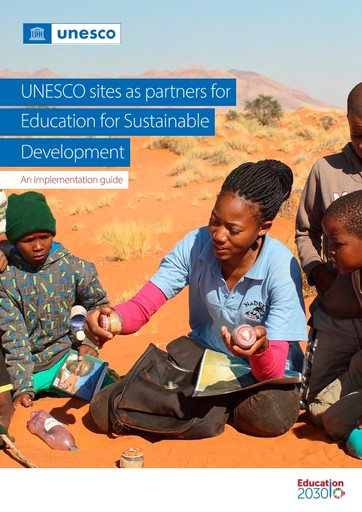
The aim of this handbook is to offer practical suggestions and ideas for teachers, educators and site managers on how to mobilize and collaborate with UNESCO sites, including biosphere reserves, World Heritage Sites and Geoparks, to develop practical learning activities.UNESCO sites cover 6% of the earts’s land area. Slovenia also has UNESCO sites: Škocjan Caves Park, Karavanke Geopark, Idrija Geopark, Karst Geopark, etc. The general approach is to promote sustainable climate and environmental actions based on ongoing projects in UNESCO sites around the world, and to enable students to experience the reality of sustainable development in their local contexts through these sites.
The handbook was also reviewed by Dr. Gregor Torkar (University of Ljubljana, Faculty of Education and UNESCO Chair on Teacher Education for Sustainable Development.
https://unesdoc.unesco.org/ark:/48223/pf0000393024
Developing 21st Century Skills: generations for quality innovation, resilience, leadership and sustainability
In the fast-paced environment of the 21st century, developing a comprehensive set of skills is crucial for individuals’ success in their personal and professional lives. A world characterised by technological advances and global connectivity requires traditional academic education to be enhanced with skills such as critical thinking, creativity, communication, collaboration and digital competences. These competences enable individuals not only to keep pace with change, but also to actively co-create and lead it in an increasingly complex and information-rich world.
The challenge facing contemporary education is to integrate these skills into curricula and professional development programmes in a way that goes beyond routine learning and encourages practical and innovative knowledge creation and application. It is a social imperative that goes beyond individual subjects and disciplines, enabling future generations to meet global challenges, innovate and lead in dynamic, fast-changing environments. The successful development of these skills requires collaboration between educators, policy makers and business leaders who together can create an enabling environment to prepare individuals for the challenges of the future.
Research shows that despite efforts to integrate sustainable development into education programmes, the focus is still predominantly on goals related to the quality of education, while other SDGs such as environmental responsibility, social justice and economic sustainability are often under-represented. This lack of holistic integration underlines the need for a strategic approach that systematically integrates a broader set of SDGs, thereby making education more relevant.
In addition to sustainable development, digital transformation is also playing an important role, changing the way we learn and teach. Digital literacy, including the use of advanced tools and techniques, is becoming a key competence for teachers and students. However, research shows that the increased use of technology in education does not in itself improve the quality of teaching. A key factor is the adequate training of teachers to use these tools meaningfully and effectively, which requires continuous professional development and adaptation of pedagogical approaches. Interdisciplinarity and metacognitive approaches that enhance the understanding and application of more complex concepts should also be encouraged.
Innovative pedagogical approaches such as design thinking, systems thinking, collaborative learning, transformative learning and problem solving are proving effective in developing 21st century competences. These approaches encourage learners to become active knowledge creators and to participate in the design of solutions to complex challenges. Special emphasis should also be given to the inclusion of learners with special needs, as inclusiveness contributes to the development of a more comprehensive education system that is adapted to the needs of all individuals.
Sustainable development, green chemistry and the re-use of materials are key concepts for promoting environmental awareness and responsible behaviour. School systems need to emphasise the importance of interdisciplinary approaches that enable students to gain a deeper understanding of natural processes and the interconnections between science, technology and society. Moreover, the key to fostering a transformation towards sustainability lies in competences such as systems and strategic thinking, social skills, self-regulation, normative values and anticipatory thinking. In addition, it is essential to increase young people’s interest in science and technology professions, as these are key to future economic and technological development.
Successful integration of 21st century skills into education programmes requires close cooperation between educational institutions, teachers, parents and the wider community. School systems need to continuously adapt to the changing needs of society and to foster innovation, resilience and creativity among learners. The goal of modern education is to produce well-rounded individuals who are not only successful in their professional careers, but also responsible citizens, capable of critical thinking and of contributing to the solution of global challenges.
Developing 21st century skills is not just an educational trend, but a fundamental task that requires a holistic and multidisciplinary approach. Investing in knowledge that goes beyond factual learning is the key to creating a generation ready for quality innovation, sustainability and leadership in the future.
http://pefprints.pef.uni-lj.si/7541/1/Avsec_Monografija_2024.pdf
Educating for sustainable development in a polarized world
At the inauguration of the new UNESCO Chair in Teacher Education for Sustainable Development at the University of Ljubljana, Prof. Dr. Daniel Fischer, Professor for Sustainability Education and Communication and Chairholder of the UNESCO Chair on Higher Education for Sustainable Development, delivered a keynote lecture on the challenges and opportunities in Education for Sustainable Development (ESD).
Prof. Fischer noted that despite progress in ESD over the past few decades, including the adoption of the Sustainable Development Goals (SDGs) and the establishment of UNESCO’s ESDfor2030 program, teacher education continues to lag behind in its implementation. He emphasized the importance of developing a needs-based approach to sustainability education, which centers education around the notion of meeting human needs in just and safe ways.
This approach can help to reorient what and how we teach, moving away from a focus on problems and awareness-raising towards a more positive and solution-oriented vision. By prioritizing the development of learners’ capacities to meet their needs and unfold their potentials as human beings, a needs-based approach can also help to design schools and educational settings in more comprehensive and humane ways, transforming them into sites where sustainability can be lived and experienced.
For example, this might involve designing learning spaces that promote social interaction, creativity, and well-being, rather than simply focusing on academic achievement. It might also involve developing alternative forms of assessment, such as peer assessment, self-assessment, and project-based assessment, which can help to move away from traditional, high-stakes testing and towards more authentic and meaningful forms of promoting learning.
In addition to reorienting what and how we teach, a needs-based approach can also help to cultivate reflexivity and mindfulness in educators, enabling them to think critically about their own needs and satisfiers, and to develop more effective solutions to complex sustainability challenges.
Link to the PowerPoint presentation
Special issue of the Nordic Journal of Comparative and International Education
A special issue of the Nordic Journal of Comparative and International Education (NJCIE) titled Interdisciplinary Approaches to Education for Sustainable Development (2024, vol. 8, no. 4) has been published. The issue was co-edited by three UNESCO Chair holders: Prof. Dr. Robert Didham (Norway), Prof. Dr. Hiroki Fujii (Japan), and Prof. Dr. Gregor Torkar (Slovenia). The issue gathers contributions from various authors.
The aim of this special issue is to collect and share new research and innovations in the emerging field of interdisciplinary education for sustainable development. You can read more about the contributions in the editorial, which also provides the editors’ reflections on multidisciplinarity, interdisciplinarity, and transdisciplinarity. Here is a brief excerpt from the editorial, prepared by the editors:
A discipline is recognized as a field of study or subject, and the word discipline can also be defined as a rule or system of rules governing behavior or activity. While the latter definition may seem less relevant when discussing educational subjects, each has traditionally developed as its own academic field, guided by its own rules, procedures, and approaches, which differ from other fields. When we add different prefixes to the discipline, we begin to think about different ways of working across disciplines. “Intra-” means within or among, and intradisciplinary refers to working within a single subject (also known as monodisciplinary). “Cross-” means between or involving different groups, and interdisciplinary is the viewing of one discipline through the lens of another.
Multidisciplinarity: “Multi-” means many, and multidisciplinarity involves different subjects or disciplines exploring the same question or topic and sharing their various insights and perspectives on it. Multidisciplinarity creates collaboration among individuals from different disciplines who work together; however, at this level, all individuals rely solely on their own disciplinary knowledge, and there is little integration of these different perspectives. Multidisciplinary education requires the coordination of curricula so that different subjects address a common theme simultaneously. Nevertheless, it does not require that individual subjects combine teaching with other subjects or integrate desired learning outcomes.
Interdisciplinarity: “Inter-” means between, but it can also mean together or mutually. The goal of interdisciplinarity is to connect knowledge and methods from different disciplines to create a true synthesis of approaches. Many modern fields of study, such as gender studies, neuroscience, and cybernetics, have naturally incorporated an interdisciplinary approach to achieve a more holistic understanding. Interdisciplinary education is a step forward in this collaborative learning process. At this level, the integration of subjects is not only targeted, but the development of the whole learner through the integrative application of knowledge, skills, and values in the context of applied learning is also the focus.
Transdisciplinarity: “Trans-” refers to across or beyond, but it can also mean thoroughly changing, as in transformation. The goal of transdisciplinarity is to create a unity of intellectual frameworks beyond disciplinary perspectives and to involve actors from different fields and sectors of society. Transdisciplinarity seeks to extend this collaboration to a place where the unity of these different disciplinary frameworks can be achieved, going beyond any single disciplinary perspective. It also clearly defines its starting point as real-world issues and promotes greater collaboration among various actors, including academics, policymakers, local communities, and businesses. Transdisciplinary education involves exploring a relevant concept, issue, or problem that brings together perspectives from multiple disciplines to connect new knowledge and deeper understanding with real-life experiences. Transdisciplinary learning is inherently collaborative and works to create an overall unity between different ways of viewing and understanding the world around us.
The following image (Figure 1) shows a visual representation of these three concepts and the degree of interaction between different disciplines. For multidisciplinarity, each discipline interacts with the subject focus (depicted by the orange circle) from its own perspective, with individual views on the subject from each discipline being juxtaposed, but with no actual overlap or merging of knowledge. For interdisciplinarity, there is active interaction between disciplines and an effort to blend different bodies of knowledge to achieve a synthesis of understanding. For transdisciplinarity, the subject becomes the main framework, and the boundaries between disciplines dissolve. Additionally, transdisciplinarity involves active engagement with the real world and non-academic stakeholders (depicted by the purple oval).
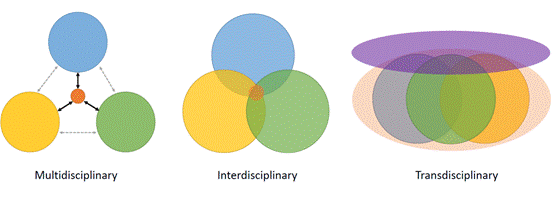
Figure 1. Visual Representation of Multidisciplinary, Interdisciplinary, and Transdisciplinary Concepts.
Modri, rumeni in zeleni krogi predstavljajo različne discipline; oranžni krog = tema fokusa/študije; vijolični oval = predstavlja sodelovanje z akterji in/ali težavami iz resničnega sveta.
More on the especial issue:
https://journals.oslomet.no/index.php/nordiccie/issue/view/499
The international educational platform Teachers’ Academy for Sustainable Development offers a dynamic space for collaboration, knowledge exchange, and professional growth. The Academy hosts lectures and a variety of video content tailored for teachers, students, and other stakeholders. All sessions are recorded and made freely available, ensuring wide accessibility and lasting impact.
https://teachersacademy4sustainabledevelopment.si/
Organized by the UNESCO Chair on Teacher Education for Sustainable Development at the University of Ljubljana, in collaboration with the University of Klagenfurt, the Private University College Augustinum, and the National and Kapodistrian University of Athens.
Detailed Programme for the BIP Week in Ljubljana (20 – 24 April 2026)
Lecture 1: Introduction to Environment and Sustainable Development: Human Drivers of Environmental Change and Global Challenges
Prof. dr. Gregor Torkar
Lecture 2: Bio-geo-chemical cycles and anthropogenic influences
Prof. dr. Iztok Devetak
Lecture 3: Teaching Nature: Exploring the Relationships between Outdoor Learning and Sustainability Education
Prof. dr. Christiana Glettler
Lecture 4: Teaching the 17 Sustainable Development Goals Through Social and Emotional Learning
Prof. dr. Evangelia Mavrikaki & Prof. dr. Myrto Koutra
Lecture 5: Sustainable Nutrition: Food for People and the Planet
Prof. dr. Stojan Kostanjevec
Lecture 6: Introductory lecture on soils
dr. Borut Vrščaj
Lecture 7: Environmental and Sustainability Education and Whole Institution Approach: Concepts and the Austrian ÖKOLOG Network
Prof. dr. Franz Rauch
– Rauch-Pfaffenwimmer-Book Green Schools- ÖKOLOG-2020
– Journal Sisyphus-Rauch-Dulle-Ecolog quantitative evaluation
– ESEinAUSTRIA-Rauch-Glettler-Steiner-Dulle-final-2024
Coffee break with foxes
mag. Črt Frelih
Lecture 8: Embedding One Health in Science Education: A Reflexive and Transdisciplinary Framework for Science Teacher Education
Prof. dr. Ulrich Hobuch et al.
Lecture 9: Promoting science through the Forests of Experiments at the Slovenian Forestry Institute
Dr. Urša Vilhar
Lecture 10: Multipliers – Open schooling
Prof. dr. Gregor Torkar
Workshop 11: Simulating the Greenhouse Effect and the Impacts of Heatwaves on Organisms
Prof. dr. Gregor Torkar
The advisory board of the UNESCO chair includes experts and representatives of institutions working in the field of sustainable development, education for sustainable development, and higher education. The groups are still in the making.
International Advisory Board
National Advisory Board
prof. dr. Gregor Torkar
Head of the UNESCO Chair
University of Ljubljana, Faculty of Education
Kardeljeva ploščad 16, 1000 Ljubljana, Slovenia
T: 00 386 1 5892 312
E: Gregor.Torkar@pef.uni-lj.si